Voltly
Danish power prices — and what waiting is worth.
The price right now, every hour of the day, and when it pays to wait. For iPhone.
In development. Not on the App Store yet.
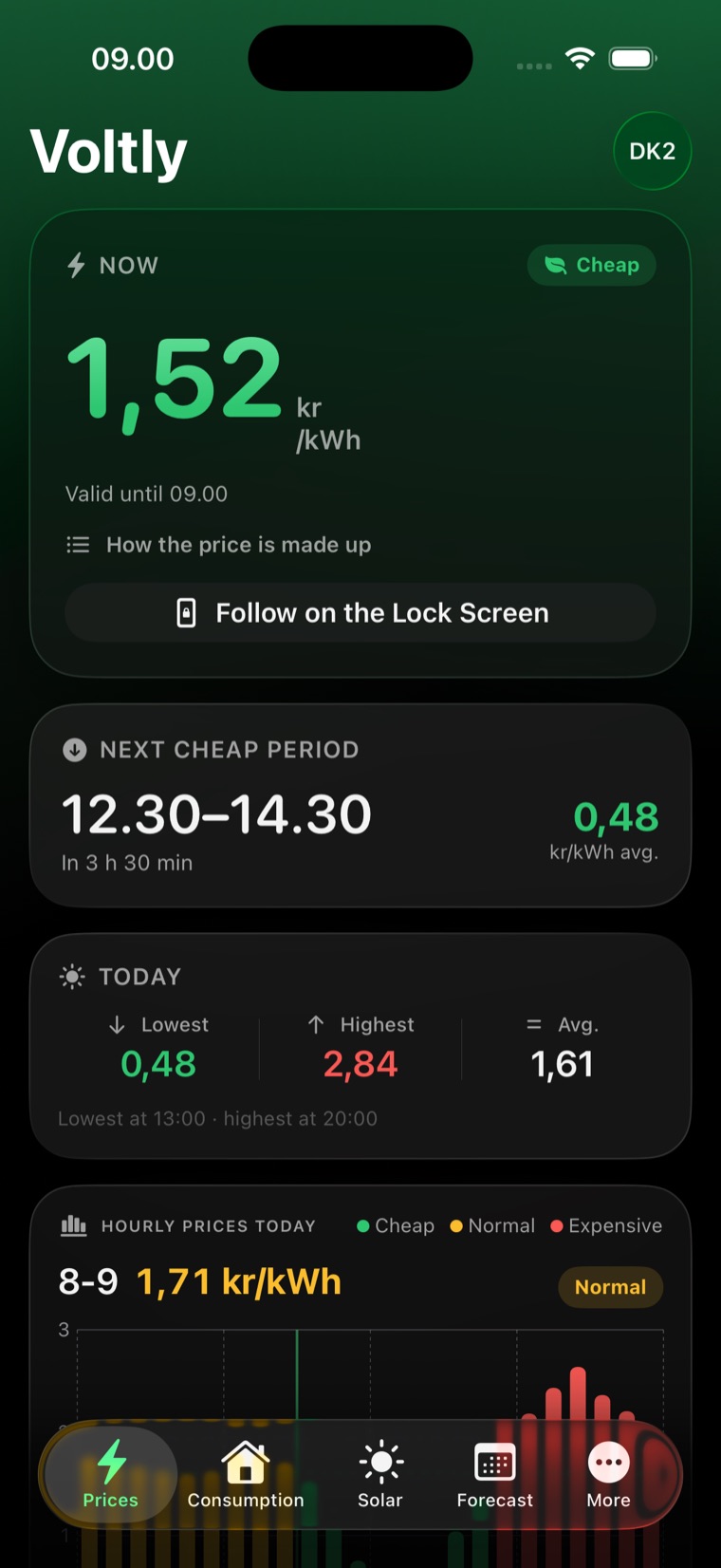
The price right now, every hour of the day, and when it pays to wait. For iPhone.
In development. Not on the App Store yet.
Prices come from Energi Data Service, Energinet's open API, in quarter-hour resolution for DK1 and DK2. Voltly shows them as the price that lands on the bill: spot plus grid tariff, electricity duty, system and transmission tariffs, supplier markup and VAT.
With a level that says whether it is cheap or expensive compared to the rest of the day — not a fixed threshold that fits February and not July.
Drag your finger across the chart to read any single hour. Tomorrow's prices appear once the market publishes them, around 13:00.
Tap into the day for a list with a bar and a price for every hour, and the lowest, current and highest at the top.
Add your appliances with consumption and run time. The app finds the cheapest window in the next 24 hours and tells you what it is worth: move the charge from now to 13:00 and you save 27 kroner.
Get told when the price drops below your threshold, or ahead of the cheapest period. Scheduled locally on the phone — they work offline too.
The price on your Home Screen in five sizes, and a Live Activity counting down to the cheap window.
Connect the app to Energinet's Eloverblik and the prices turn into kroner. You fetch a data access token yourself at eloverblik.dk after signing in with MitID and paste it into the app — there is no MitID login available to an app like this, and the token never travels anywhere except to Energinet.
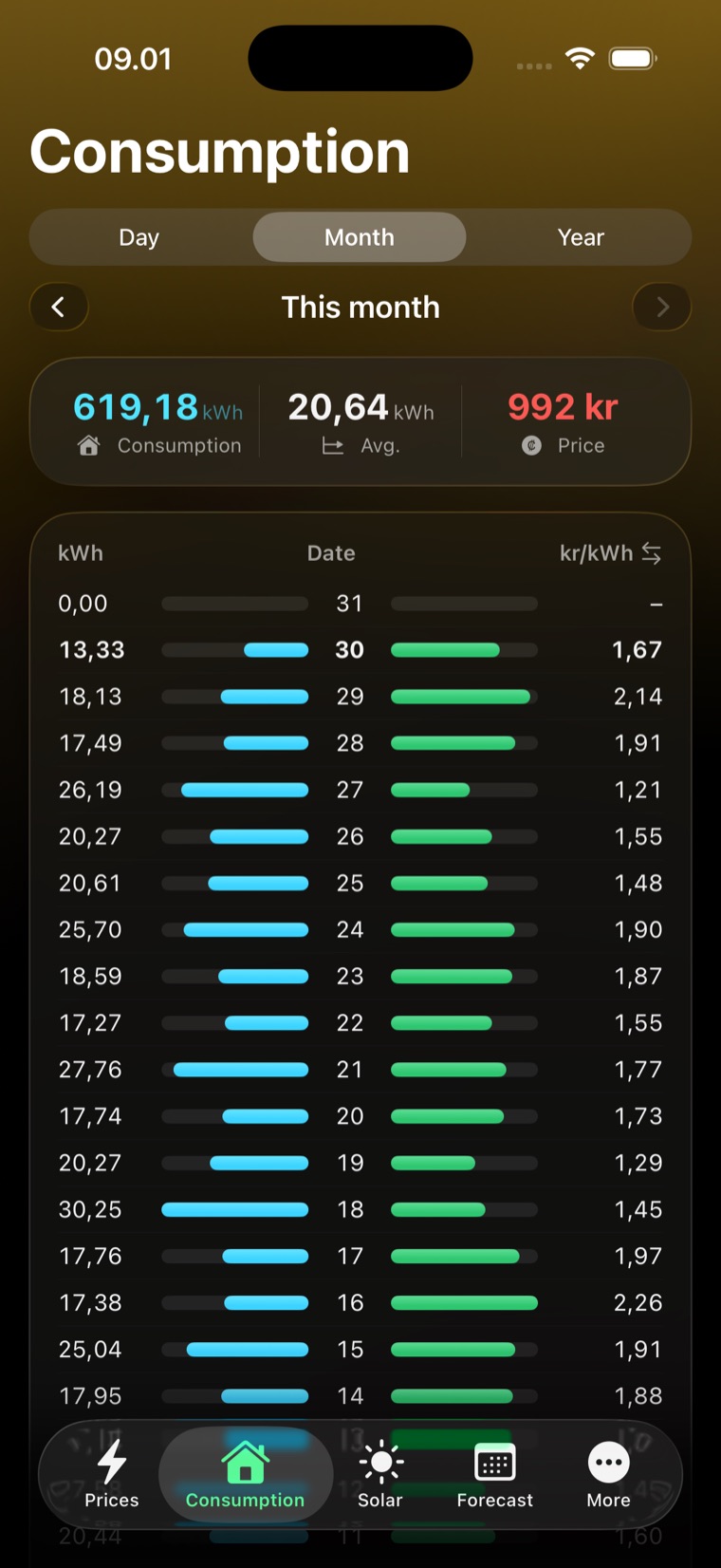
Consumption
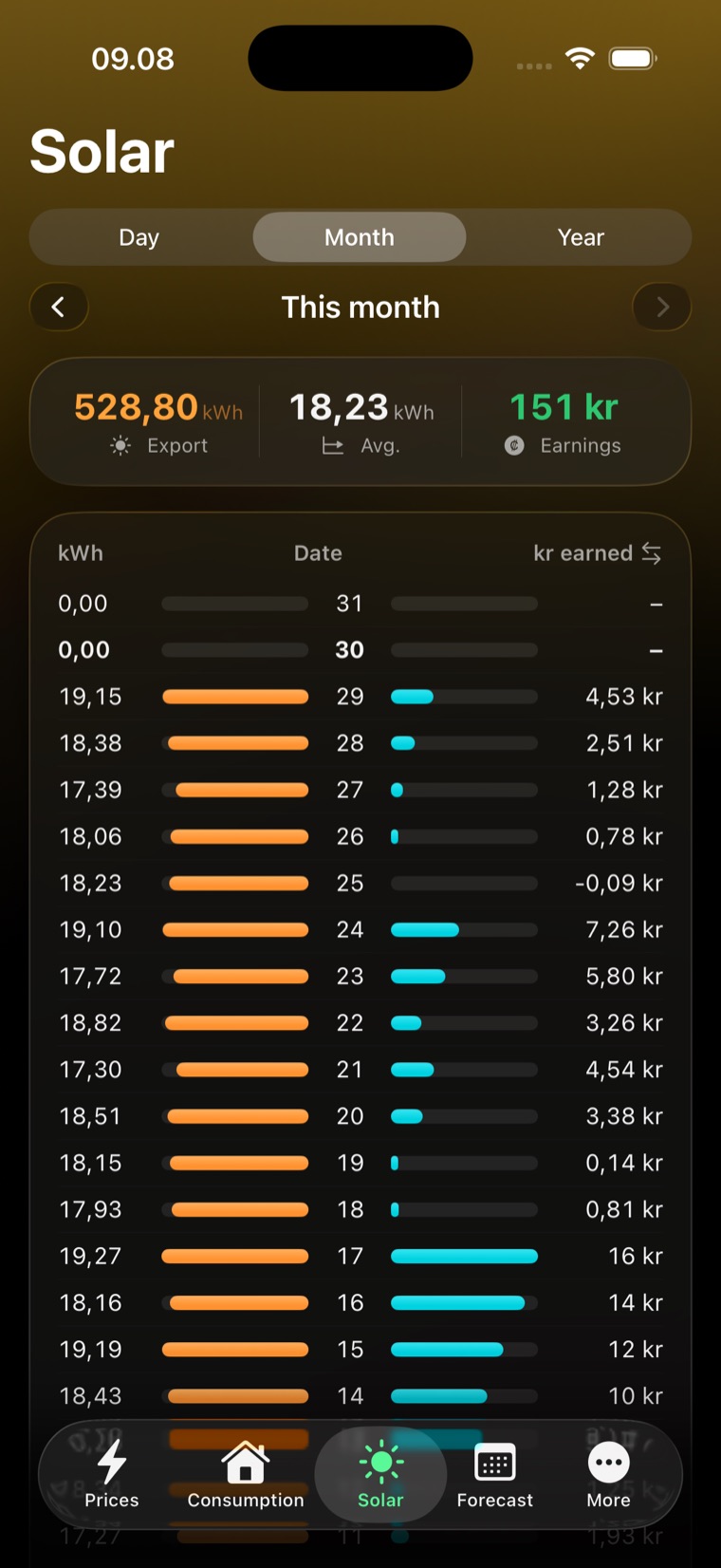
Solar
The electricity market only publishes today and tomorrow. The rest is a calculation, and the app says so plainly.
Everything that comes straight from the market — today's and tomorrow's prices, charts, alerts, widgets, consumption and solar — is free and stays free.
No account, no server, no tracking. There is nowhere for your figures to sit, because they sit on the phone.
| What | Where it comes from | Where it lives |
|---|---|---|
| Electricity prices | Energi Data Service (Energinet), the DayAheadPrices dataset | On the phone |
| Grid tariff | Energinet's DatahubPricelist for your grid company | On the phone |
| Consumption and export | Eloverblik, with your own data access token | On the phone |
| Data access token | You, from eloverblik.dk | The phone's keychain |
| Settings | You | The phone, and iCloud if you want |
| Tracking and analytics | — | None |
The supplier markup is the one part of the price the app cannot look up: it is your agreement with your electricity supplier and appears in no public register. So a figure is shown only for the suppliers where it has been checked against a real bill — for the rest you enter what is on yours.